
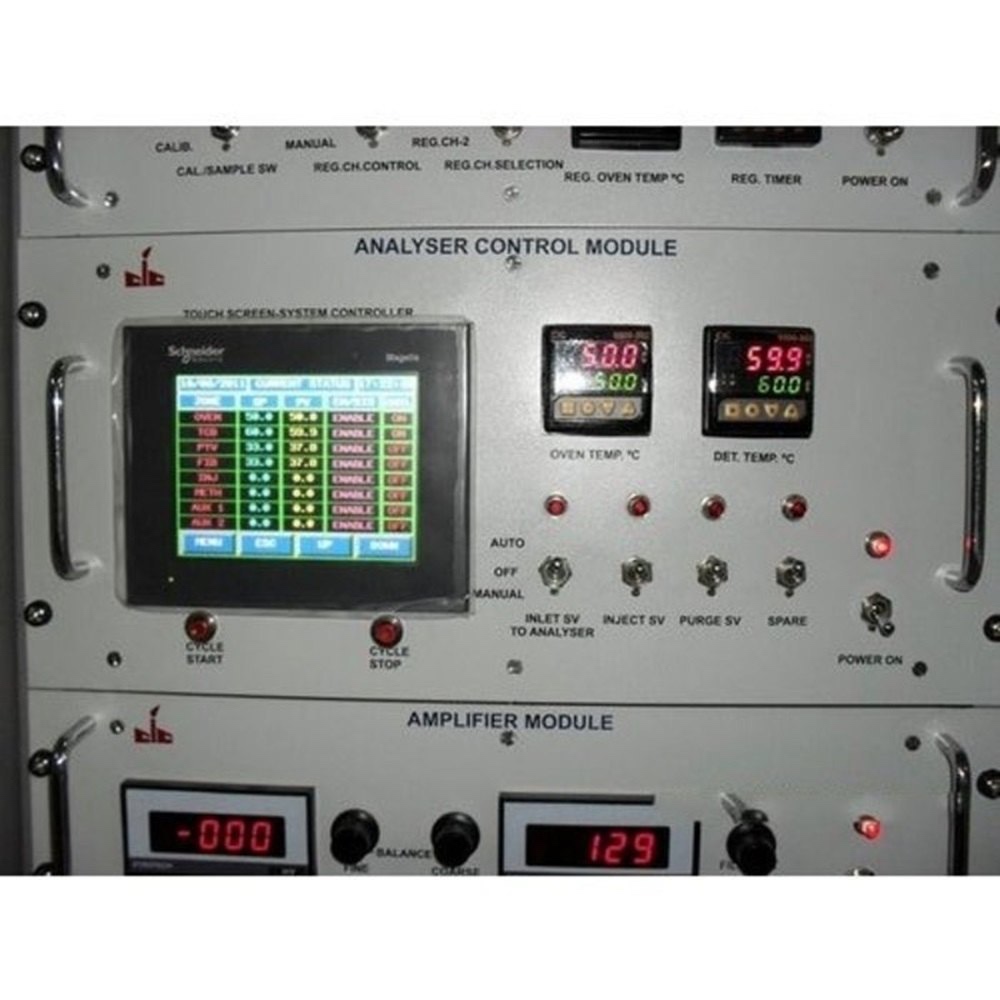
A Process Gas Chromatograph (PGC) is an analytical instrument used to separate and analyze chemical components in gas mixtures.
It is widely used in industries such as oil and gas, petrochemicals, and chemical manufacturing.
The instrument works by passing a gas sample through a column where different components separate based on their properties.
A carrier gas, such as helium or nitrogen, transports the sample through the system.
Each component exits the column at a different time, known as the retention time.
Detectors identify and quantify each component as it leaves the column.
PGCs provide continuous, real-time monitoring of process streams.
They help ensure product quality, safety, and process efficiency.
The system is often automated and integrated with control systems for process optimization.
Regular calibration and maintenance are essential for accurate and reliable performance.A Process Gas Chromatograph (PGC) is an automated, on-line analytical instrument that separates and measures multi-component gas or volatile liquid samples in industrial environments for real-time process control.
Measurable objects Gases or volatile liquids (400°C or lower boiling point)
Analysis method Gas chromatography
Measurable range TCD: 1 ppm to 100%
MTCD: 1 ppm to 100%
FID: 1 ppm to 100%
FID with methanizer: 1 ppm to 0.1%
FPD: 1 ppm to 0.1%
Number of components to be measured Maximum of 999 (total number of components in all streams including calibration standard sample stream)
Analysis period Maximum of 21600.0 seconds (six hours)
Number of streams to be measured Maximum of 31 (including calibration standard sample stream)
Material of sample-contact parts RV: 316SS, Hastelloy-C, Rulon, PTFE (Teflon, Bearee)
LSV: 316SS, Hastelloy-C, Rulon, PTFE (Teflon, Bearee), Glass, Fluororubber (Viton), perfloroelastomer (Kalrez)
Repeatability Depends on analysis conditions.
Gas sample: ±1% of full scale for measuring ranges (2σ)
Liquid sample: ±2% of full scale for measuring ranges (2σ)
Analyzer
Type of protection Pressurized enclosure, flame proof enclosure, increased safety, intrinsic safety and type of protection
Certification standard: TIIS, JPEx (CML), FM, CSA, ATEX (DEKRA), IECEx (DEKRA), NEPSI
TIIS (Type1 to 4): Ex pd IIB+H2 T1 to T4
JPEx (Type1 to 5):Ex db pxb IIB+H2 T1, T2, T3 or T4 Gb
FM/CSA:
Type X Pressurization and Explosionproof for Class I, Division 1, Groups B, C and D. T1 to T4
Type X and Y Pressurization for Class I, Division 1, Groups B, C and D. T1 to T4
ATEX:
II2G Ex db pxb IIB+H2 T1, T2, T3 or T4 Gb
II2G Ex db ec ic nC pxb pyb IIB+H2 T3 or T4 Gb
IECEx:
Ex db pxb IIB+H2 T1, T2, T3 or T4 Gb
Ex db ec ic nC pxb pyb IIB+H2 T3 or T4 Gb
NEPSI:
Ex db pxb IIB+H2 T1, T2, T3 or T4 Gb
Ex db ec ic nC pxb pyb IIB+H2 T3 or T4 Gb
Protection degree of enclosure Type 3R (ANSI/UL 50E, CSA C22.2 No. 94.2) 、Equivalent to IP54 (IEC 60529) (dust and water resistant structure)
Ambient condition during operation -10 to 50°C, 95 % RH or less (no condensation)
Depends on analysis conditions.
Weight Wall-mounting version Self-standing version
Type 1 Approx. 100 kg Approx. 140 kg
Type 2 Approx. 155 kg Approx. 190 kg
Type 3 Approx. 200 kg Approx. 220 kg
Type 4 Approx. 140 kg Approx. 170 kg
Type 5 Approx. 175 kg Approx. 195 kg
Type 6 Approx. 85 kg