
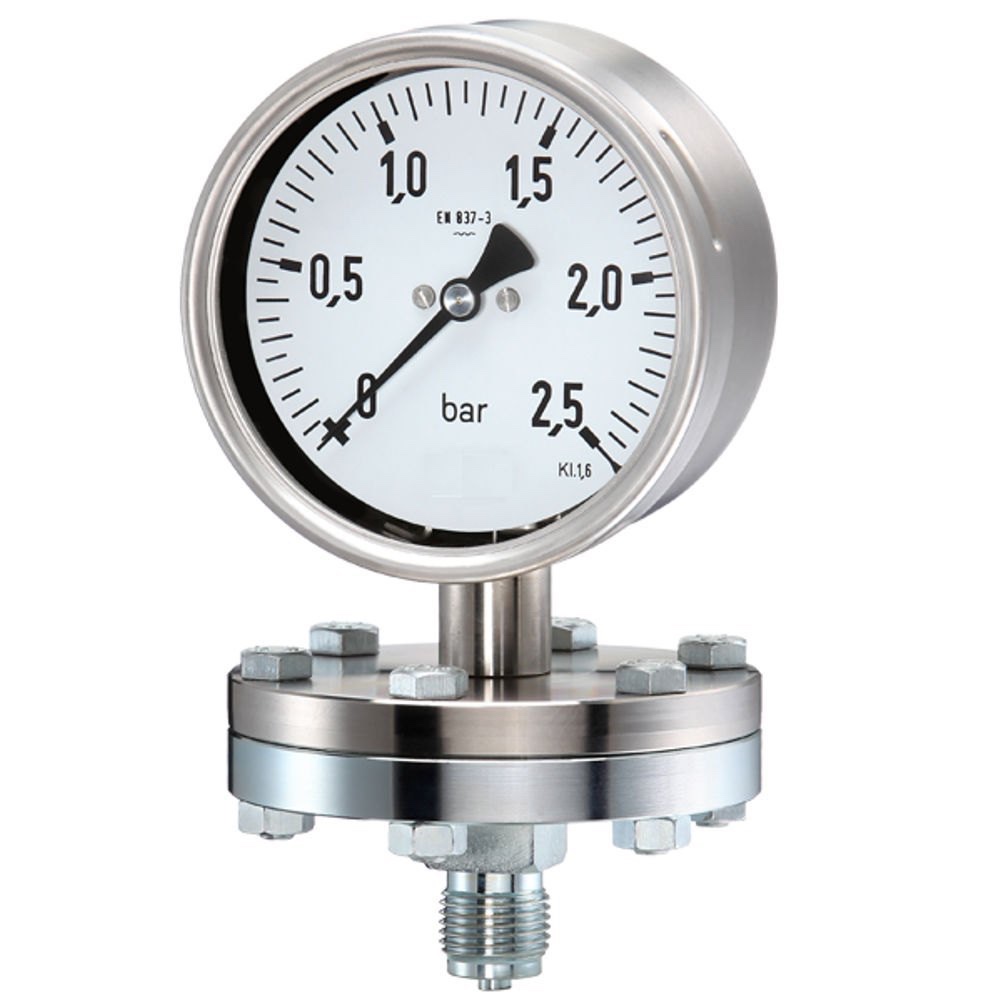
A Diaphragm Pressure Gauge is an instrument used to measure low to moderate pressure of gases and liquids. It consists of a flexible diaphragm, usually made of metal or elastomer. When pressure is applied, the diaphragm deflects or deforms. This deformation is proportional to the applied pressure. The movement of the diaphragm is transmitted through a mechanical linkage. The linkage drives a pointer across a calibrated dial to show the pressure reading. It is especially suitable for measuring low pressures and differential pressures. Diaphragm gauges are commonly used in chemical, food, and pharmaceutical industries. They can handle corrosive and viscous fluids with proper material selection. Overall, it is a sensitive and accurate device for pressure measurement.Diaphragm pressure gauges are specialized instruments used to measure low-pressure, viscous, or corrosive media, separating the process fluid from the mechanism using a flexible membrane.
Standard
Pressure gauges (manometer) for fire pumps DIN 14421
Diaphragm and capsule pressure gauges EN 837-3
→ For information on the “Selection, installation, handling and operation of pressure gauges”, see technical information IN 00.05.
Nominal size (NS) ■ Ø 80 mm [3“]
■ Ø 60 mm [2.4“]
■ Ø 100 mm [4“]
Connection location ■ Lower mount (radial)
■ Centre back mount
Window ■ Polyamide (PA)
■ Acrylic glass (PMMA)
Case
Design Safety level “S1” per EN 837-3: With blow-out device
Material Stainless steel 1.4301 (304)
Illumination ■ Without
■ LED light bulb, 3 W, DC 24 V, BA9s lamp holder 1)
Mounting ■ Triangular profile ring, polished stainless steel
■ Triangular profile ring, aluminium, black painted
■ Panel mounting flange, polished stainless steel
Case filling 2)
■ Without
■ Silicone oil
■ Glycerine
Movement Copper alloy