
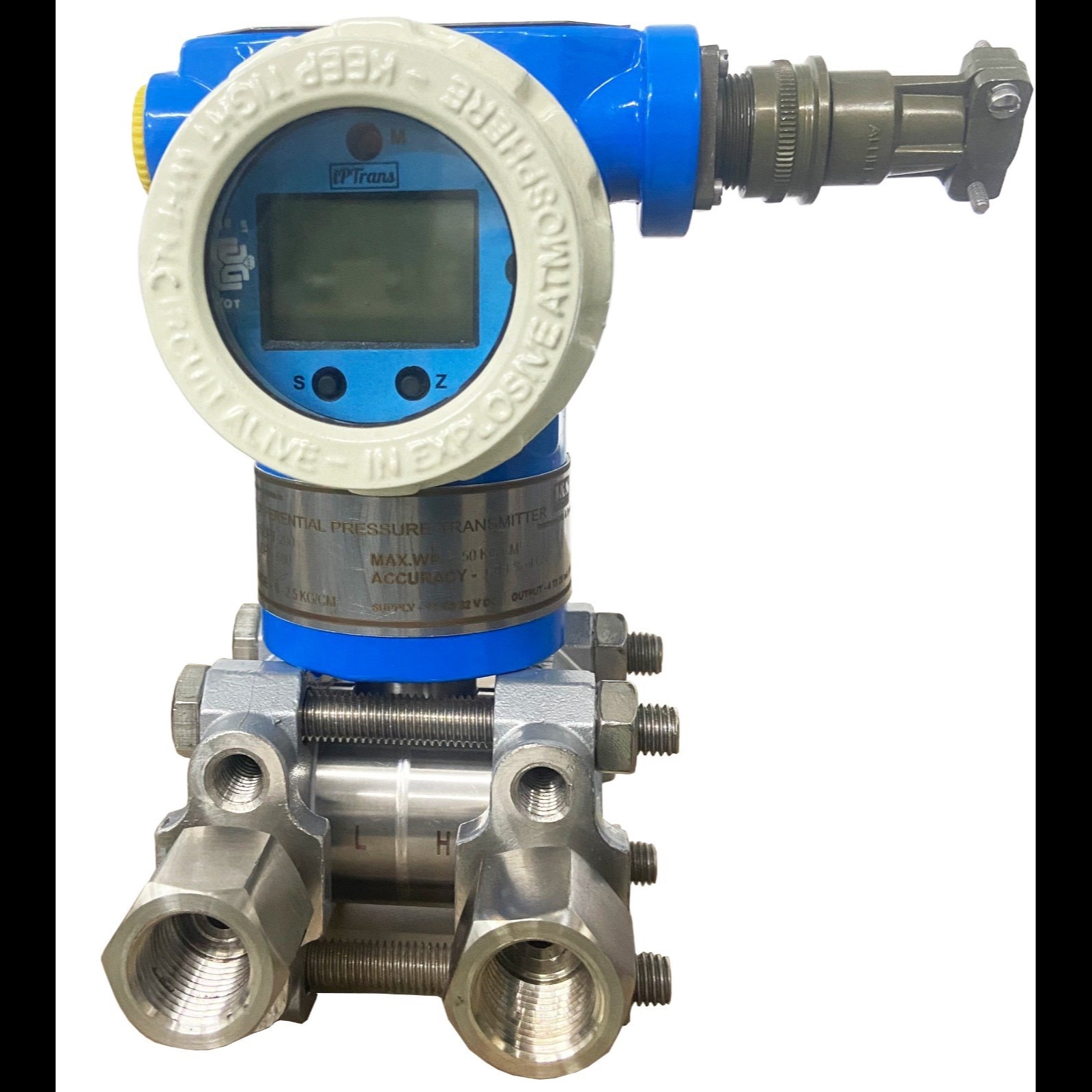
A Differential Pressure (DP) Transmitter is an instrument used to measure the difference in pressure between two points in a system.
It is widely used in industrial process control and automation applications.
The device senses high pressure and low pressure through two separate input ports.
The pressure difference is converted into an electrical output signal.
Typical output signals are 4–20 mA, 0–5 V, or digital communication signals.
DP transmitters are commonly used in flow, level, and filter monitoring applications.
In flow measurement, it works with primary elements like orifice plates and venturi tubes.
The pressure difference produced by fluid flow is proportional to the flow rate.
The transmitter contains sensing elements such as diaphragms or capacitive sensors.
These sensing elements detect minute pressure changes accurately.
Modern DP transmitters use microprocessor-based electronics for signal processing.
They provide high accuracy, stability, and fast response.
Many transmitters support smart communication protocols like HART, Modbus, or Foundation Fieldbus.
They can operate in harsh industrial environments with high temperature and vibration.
DP transmitters are widely used in oil and gas, chemical, power, and water treatment industries.
They help in monitoring tank levels by measuring hydrostatic pressure differences.
The transmitter requires periodic calibration for accurate performance.
Some models include digital displays for local indication of measured values.
Proper installation improves reliability and reduces measurement errors.
Differential Pressure Transmitters play an important role in industrial automation and process safety.
DP Range 0–10 bar
Application Level
Output Signal 4–20 mA HART
Process Connection ½ in NPT
Turn Down Ratio 100:1
Diaphragm Material SS316L
Accuracy ±0.075%
Mounting Type 2 in Pipe
Hazardous Approval Intrinsically Safe
Pressure Range – Measures differential pressure within a specified range such as 0–100 Pa to 0–40 bar.
Accuracy – Typical accuracy ranges from ±0.1% to ±0.5% of full-scale output.
Output Signal – Provides standard industrial outputs like 4–20 mA, 0–10 V, or digital communication signals.
Power Supply – Operates on DC supply, commonly 12–36 V DC.
Response Time – Fast response time for quick detection of pressure changes.
Operating Temperature – Functions reliably within a specified temperature range such as –20°C to +85°C.
Sensor Type – Uses capacitive, piezoresistive, or strain gauge sensing elements.
Communication Protocol – Supports protocols like HART, Modbus, or Foundation Fieldbus for smart monitoring.
Overpressure Protection – Designed to withstand pressure beyond the rated range without damage.
Enclosure Protection – Available with industrial protection ratings such as IP65, IP67, or explosion-proof housing for harsh environments.
Get smarter responses, upload files and images, and more.